With the upcoming celebration of Independence Day here in the U.S. I wanted to share some inspiring stories of people who have helped create “independence” for others. They are an inspiration to us all.
 Sir Nicholas Winton saved 669 children–taken from cbsnews.com
Winton’s story begins in 1938 in London, where he was a 29-year-old stockbroker enjoying the good life. The son of German-Jewish immigrants, he had been following the rise of Hitler and the Nazis and knew they were on the march. He was convinced war was imminent. Hitler’s troops had just marched into Czechoslovakia and occupied the region known as the Sudetenland, creating the war’s first refugee crisis. At least 150,000 people had fled to makeshift refugee camps that sprang up around Prague. The conditions they faced were dire.
When a friend suggested that Winton cancel his annual ski trip and join him in Prague to see what was going on, Winton decided to use his vacation days and go. The situation he encountered was desperate. Efforts by organizations trying to help refugees were hampered by the fact that most countries in Europe weren’t willing to take them in. Winton also told us he wrote to President Roosevelt asking the U.S. to receive them, to no avail.
Parents were frantically trying to get their children out, so Winton decided to focus his efforts on helping those children. He had no background or experience in dealing with refugees, but was about to take on the Nazis and the British bureaucracy in a remarkable feat of skill, determination and cunning. During the few days he was in Prague, Winton laid the groundwork for an organization to transport children to Britain on trains. He identified people willing to help, met with parents determined to get their children out, and started making lists of children whose parents wanted them to go.
When he returned to London, he set up a fake organization, appointed himself chairman, put his mother to work running a small office, and began negotiations with the British government for permission to bring unaccompanied minors into England. Meanwhile, he looked for families to take them in. He raised money, paid bribes, procured transit papers and, when necessary, forged documents. When Bob Simon asked him about all of that he was unapologetic — saying simply, “It worked.”
Everything finally came together on March 14, 1939, when the first train carrying 20 children left Prague. Neither the children nor their parents knew this was likely the last time they would ever see each other. Six more trains left between March and August 1939.
An eighth train, carrying 250 children, was scheduled to leave on September 1, 1939, but that was the day Germany bombed Warsaw, beginning the Second World War. Borders were closed and transportation halted. The eighth train never left. No one knows for sure what happened to the 250 children who were already in their seats that day. They and their families are presumed to have died in the Holocaust.
The war ended Winton’s efforts to save children. His organization shut down operations and he moved on with his life. He made no attempt to contact the children he had saved. They had been dispersed all over Britain, so he got on with his life. During the war, he served in the Red Cross and the Royal Air Force. Following the war, he worked repatriating assets seized by the Nazis, went back to his career in finance, got married and raised a family.
Rarely did he ever talk about his efforts to save children. When Bob asked him why, Winton said he wasn’t trying to keep it a secret – he just never talked about it. Maybe it’s because the Holocaust had claimed all the children he hadn’t gotten out or maybe it’s because Winton really didn’t believe he had done anything out of the ordinary.
At the beginning of our interview he told us that he’s always felt that, “If something’s not impossible, there must be a way of doing it.” Nicholas Winton found a way to do it in Prague and made it work. Because of him, 669 children were spared and able to have families of their own. Today, some 6,000 people are alive who wouldn’t be if it weren’t for Nicholas Winton.
Fifty years after the war, Winton’s remarkable story finally came out in a London newspaper and on the BBC. The “children” from 1939 found out who had saved them and have been celebrating Winton ever since. So has the Czech Republic and England, where Nicholas Winton became Sir Nicholas Winton after being knighted by the Queen. The original children from 1939 and their descendants all call themselves “Nick’s family.”
 Herbert Hoover–taken from archives.gov
One American will be forever linked in history with Belgium’s travail in that awful war. His name, of course, is Herbert Hoover. After the battle of the Marne, giant European armies bogged down in the trenches, and famine threatened beleaguered Belgium, a highly industrialized nation of 7 million dependent upon imports for three-quarters of her food. On one side the German army of occupation refused to take responsibility for victualing the civilian population. Let Belgium import food from abroad as she had done before the war, said the Germans. On the other side stood the tightening British naval blockade of Belgian ports. Let the Germans, as occupiers of Belgium, feed its people, said the British. Besides, they argued, how could one be sure that the Germans would not seize imported food for themselves?
As the tense days passed in the early autumn of 1914, food supplies dwindled ominously in Belgium. To the outside world went emissaries pleading for the Allies to permit food to filter through the naval noose. Finally, on October 22, after weeks of negotiations, Herbert Hoover established under diplomatic protection a neutral organization to procure and distribute food to the Belgian populace. Great Britain agreed to let the food pass unmolested through its blockade. Germany in turn promised not to requisition this food destined for helpless noncombatants.
Why Hoover? In the summer of 1914 Herbert Clark Hoover was a prosperous forty-year-old international mining engineer living in London—and dreaming of a career of public service in the United States. This orphaned son of an Iowa blacksmith had come far indeed from his humble beginnings in the American Middle West. Rising rapidly in his chosen profession, by 1914 he directed or in part controlled a worldwide array of mining enterprises that employed a hundred thousand men. By August 1914 he had achieved his goal yet was not content. “Just making money isn’t enough,” he confessed to a friend. Instead, he wanted (as he put it) to “get into the big game somewhere.” Fascinated by the power of the press to mold and direct public opinion, Hoover that summer was negotiating to purchase a newspaper in California. Events in Europe compelled him to abandon his quest. Had it not been for “the guns of August,” he would have entered American public life—and might even be remembered today—as a newspaper magnate.
In the first tumultuous weeks of the war, tens of thousands of American travelers in Europe fled the war-shocked continent for the comparative safety of London—and, they hoped, passage home. It was not as easy as that. Arriving in the British capital, many Yankee tourists found themselves unable to cash their instruments of credit or obtain temporary accommodation, let alone tickets for ships no longer crossing the Atlantic. Responding to the travelers’ panic and necessities, Hoover and other American residents of London organized an emergency relief effort that provided food, temporary shelter, and financial assistance to their stranded fellow countrymen. Eventually the passenger ships resumed their sailings, and more than 100,000 weary and frightened travelers headed back to the United States. Hoover’s untiring and efficient leadership during the crisis earned him the gratitude of the American ambassador to Great Britain, Walter Hines Page. And when a few weeks later the plight of Belgium became perilous, Ambassador Page and others agreed upon Hoover, a man of demonstrated competence, to administer this new mission of mercy. The globe-trotting mining engineer who had done well, and who now wanted to do good, had found an unexpected entrée into the “big game.”
And so began an undertaking unprecedented in world history: an organized rescue of an entire nation from starvation. Initially no one expected this humanitarian task to last more than a few months. Few foresaw the gruesome stalemate that developed on the western front. As Hoover himself later wrote, “The knowledge that we would have to go on for four years, to find a billion dollars, to transport five million tons of concentrated food, to administer rationing, novel relief organization, which went by the name of the Commission for Relief in Belgium (CRB), possessed some of the attributes of a government.
 Ken Behring–taken from Pam Grout’s book, Thank and Grow Rich
The only thing the one-percenters have over the average Joes is this: They already know that accumulating money doesn’t bring lasting happiness. They’ve already figured out that having a gazillion dollars in the bank doesn’t produce the profound contentment after which the rest of us lust.
Take Ken Behring, for example. Growing up in Depression-era Wisconsin in a house without central heat or hot water, Behring fell for the lie that he’d be happy if only he were rich. As a young boy, he mowed lawns, caddied at golf courses, delivered newspapers.
He had spunk and drive and eventually became an uber-successful real estate developer. By the time he was 27, he was a millionaire. And he got all the stuff he thought he wanted: a big house, a boat, fancy cars.
When that didn’t bring any real happiness, he tried “better stuff”: bigger houses, a bigger yacht, fancier cars.
Eventually, that began to reek like the other stuff. Maybe he was going for the “wrong stuff”; maybe he should try “different stuff.” Maybe buying the Seattle Seahawks would make him happy.
Nope, foiled again. He eventually sold his professional football team and started hunting in Africa, flying over in his private jet. When he could, he’d take supplies, books and medicine for the local guides and their families.
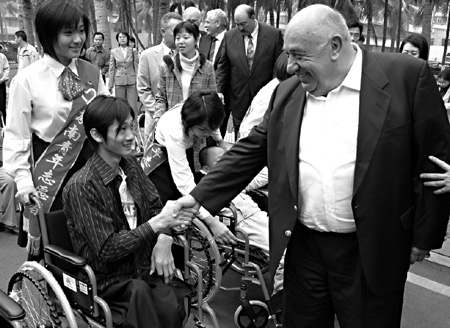
LDS philanthropies (the charitable branch of the Church of Latter-day Saints) heard about his trips and asked if he’d be willing to make a detour, to drop off supplies to Kosovo war refugees. After loading up 15 tons of canned meat, they noticed extra room and added six wheelchairs.
While in Romania, Behring, who passed out the wheelchairs himself, was grabbed by one of the young refugees, who had stepped on a land mine and lost his legs. “Don’t leave just yet,” said the grateful young boy, who refused to let go of Behring’s leg. “I want to memorize your face so when we meet again in heaven, I can thank you one more time.”
“It was the first time I ever felt real joy,” says Behring, who has since given away nearly a million bright red wheelchairs. “It changed my life. This [charitable work] is the greatest thing I have ever achieved in my life.”
The good news is that because our financial system us an antiquated cultural story, it can be changed.
It starts with a new definition of wealth: the ease and freedom to be generous. The ease and freedom to pursue your dreams. The ease and freedom to live for the upliftment of all creation.
Choosing the joy and gratitude frequency generates a different kind of capital, one that feeds the soul, one that serves your real desires–to be of service, to be a channel for love, to create insanely beautiful things.
More Stories–Here are a number of additional examples of inspired people making a difference http://www.rd.com/true-stories/inspiring/the-power-of-1-inspiring-people-making-a-difference/
Proof that one person can make a difference. Think about it!! Think about all of the people you have touched or influenced in your life. You truly are part of a ripple affect.
Have a beautiful day. -H
 This morning I had a bit of a sad and scary situation happen.
 This made me think about life & the tough situations that may come up. What makes a bad situation worse?? We run! We don’t face our fears. We get scared. We run! What makes us run? Anger, negative emotions, situations that we don’t like, shame, worry… FEAR based feelings. Life can be like that sometimes. We may not want to deal with a situation and the easy way out would be to run to avoid the pain.
 Yesterday I was able to see my six-year-old nephew who had just had a birthday. I asked him if he had got his present because I was not able to be at his party. He responded that he had got the gift, but asked if next time I would buy him the giant ship that goes with the pirate guy I had given him. I smiled and laughed at his sweet innocence. He has no concept of money & that the boat was over $80. He just knew that he wanted something bigger, better and that it went with his character. He wanted the best of everything!!
 My husband and our family have been on a rollercoaster of emotion for about four years now. My husband had been with the same company for about 15+ years when the company decided to sell and he was left without a job.
 This morning as my husband was leaving to work, I was half asleep, but I remembered something I read recently and mentioned it to him. With a huge amount of HOPE in my heart, I said, “I read something that may help you today…be SUPERMAN. Find someone you can save today. Find someone you can lift with a smile, a kind word, a compliment. FIND SOMEONE YOU CAN SAVE!! He said, “That is a great idea. I will”
 “Everything that is great in life is the product of slow growth; the newer, and greater, and higher, and nobler the work, the slower is its growth, the surer is its lasting success. Mushrooms attain their full power in a night; oaks require decades. A fad lives its life in a few weeks; a philosophy lives through generations and centuries. If you are sure you are right, do not let the voice of the world, or of friends, or of family swerve you for a moment from your purpose. Accept slow growth if it must be slow, and know the results must come, as you would accept the long, lonely hours of the night–with absolute assurance that the heavy-leaded moments must bring the morning.”
 THE POWER OF PERSONAL INFLUENCE “But his unconscious influence, the silent, subtle radiation of his personality, the effect of his words and acts, the trifles he never considers, is tremendous. Every moment of life he is changing to a degree the life of the whole world. Every man has an atmosphere which is affecting every other. So silent and unconsciously is this influence working, that man may forget that it exists.
 FAILURE AS A SUCCESS: “Our highest hopes, are often destroyed to prepare us for better things. The failure of the caterpillar is the birth of the butterfly; the passing of the bud is the becoming of the rose; the death or destruction of the seed is the prelude to its resurrection as wheat. It is at night, in the darkest hours, those preceding dawn, that plants grow best, that they most increase in size. May this not be one of Nature’s gentle showings to man of the times when he grows best, of the darkness of failure that is evolving into the sunlight of success. Let us fear only the failure of not living the right as we see it, leaving the results to the guardianship of the Infinite.”
 DOING OUR BEST AT ALL TIMES: “If a man honestly seeks to live his best at all times , that determination is visible in every moment of his living, no trifle in his life can be too insignificant to reflect his principle of living. The sun illuminates and beautifies a fallen leaf by the roadside as impartially as a towering mountain peak in the Alps. Every drop of water in the ocean is an epitome of the chemistry of the whole ocean; every drop is subject to precisely the same laws as dominate the united infinity of billions of drops that make that miracle of Nature, men call the sea. No matter how humble the calling of the individual, how uninteresting and dull the round of his duties, he should do his best. He should dignify what he is doing by the mind he puts into it, he should vitalize what little he has of power or energy or ability or opportunity, in order to prepare himself to be equal to higher privileges when they come. This will never lead man to that weak content that is satisfied with whatever falls to his lot. It will rather fill his mind with that divine discontent that cheerfully accepts the best–merely as a temporary substitute for something better.”
 You never know how you will be impacted by those who come into your life. What will you take away from those experiences of meeting new people or even going a little deeper with those you are surrounded by. We need connection. We need to learn from others and their stories.
 One of our new friends had already performed at a famous theater here in Utah as the lead. She sings, dances, sews, knits, plays the piano and guitar & is taking aerial silks. It was fun to get to know her & learn of her many talents. It was also nice to meet her mother who was from Ukraine. At one point during our afternoon I asked this young girl if she ever thought she would visit her mother’s home country to get a better understanding of her mother & her history. The girl looked at me and said, “the country has been ruined from war and I don’t know if we would ever go back. It is not like it use to be.” It was wonderful to listen to stories of how her mother grew up with a father who only put vegetables in the garden and not “beauty.” I took this young girl to a local nursery to pick out some flowers & make our own little pot of “beauty.” She walked the nursery saying, “my mother loves flowers. She would love this one. She loves petunia’s….” It made me have a whole new appreciation for “beautiful flowers.” When we dropped off our new friend, I looked at her mother’s flower pots that she had all over her yard & I thought about her perspective on “beauty” and I smiled at her pots and pots of flowers. We take so much for granted.
 Our other new friend has been suffering from an unknown illness that has put her in the hospital numerous times, has been through three surgeries and still wonders if she is going to be okay. She still has flare ups. We sat at an outdoor eatery & talked about her experiences & how she wants to go into medicine even further because of her illness. She said it was the hardest to see her parents go through everything with her. She was an incredible girl with so many hopes and dreams. I sat and listened to her explain how she had read about a doctor who spends most of his year in third world countries and how she would like to follow in his footsteps. My admiration for her dream soared. She talked about constantly learning about medicine, learning more about homeopathic medicine, trying to find different ways to cope with her illness. She was so strong & so alive & so smart and beautiful. She lit up talking about playing the guitar & piano & is constantly learning new things. She was an inspiration. I thought to myself, she is so young, has learned so much & continues to pursue anything and everything her heart desires. If we could all be like that!! Maybe being sick, wondering if you may live and always searching for answers leaves you aching for more of what life has to offer. I am sure every day is a new day filled with possibility for her.
 THE POWER OF “WE”
 Look for any opportunity in a negative situation
 Stockdale Theory
 The Candy Bomber





 yourhappyplaceblog